The water as boundary
Monks settling islands were not simply seeking solitude — they were building on an established logic. The water around an island did work analogous to the vallum: it marked a boundary between secular and sacred without the labour of raising an earthwork. The sea or lake enforced enclosure automatically. What had to be constructed on arrival was everything else.
The island sites range enormously in character. Lough Derg in County Donegal contains Station Island, where a monastic presence is attested from the early medieval period — though the devotional overlay of fifteen centuries makes stratigraphy difficult. Lough Ree and Lough Erne both held communities, and the Erne sites in particular — Devenish Island among them — preserve standing architecture: a round tower, a church, a carved high cross, all within a compact area that reflects the logic of working inside tight natural limits.
The Atlantic extreme
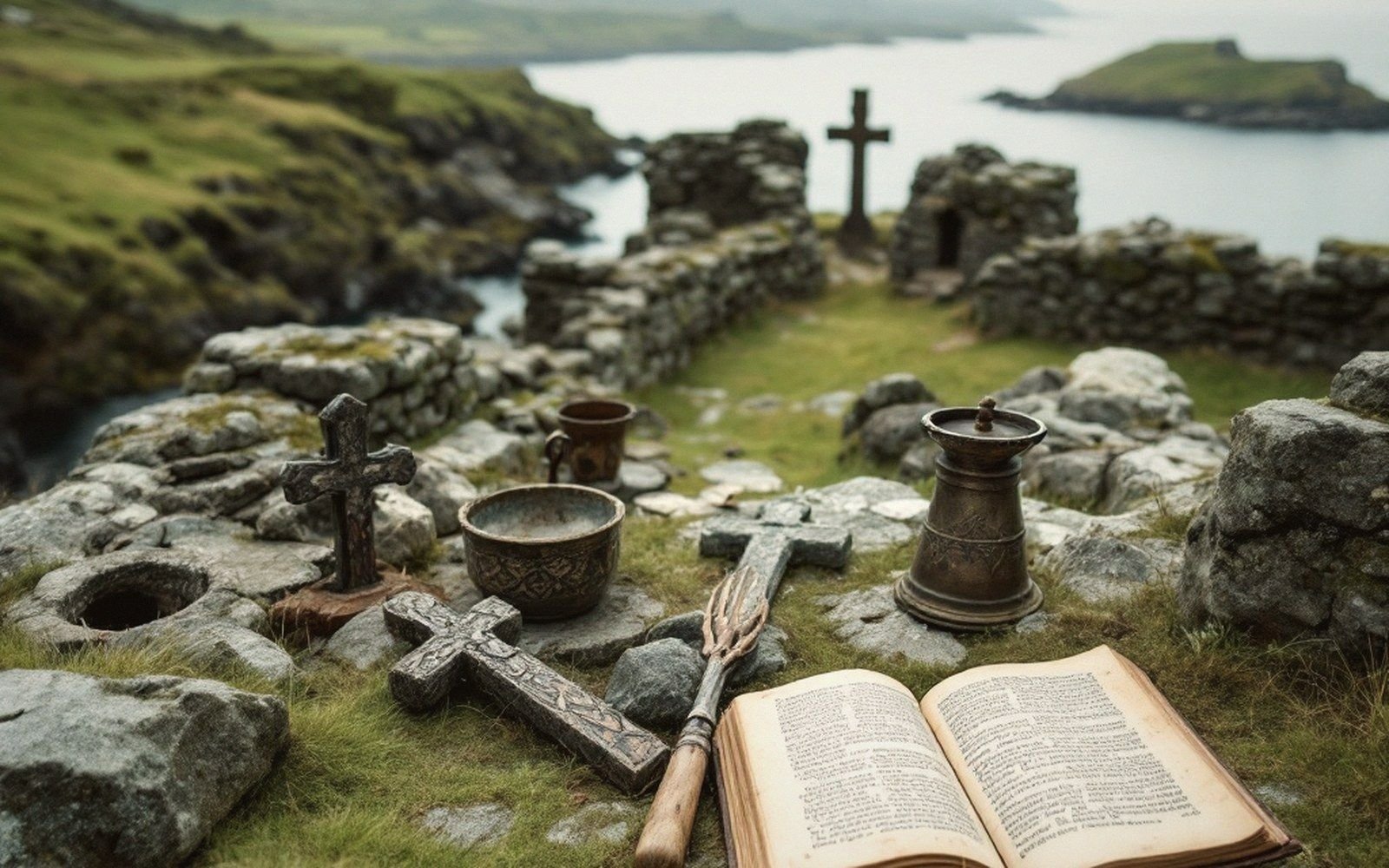
Skellig Michael, off the Kerry coast, is the site the island tradition made famous. The settlement sits roughly 180 metres above sea level on a rock that rises sharply from the Atlantic, and what survives is a group of beehive cells, two boat-shaped oratories, and a cemetery, enclosed by a dry-stone terrace wall that represents an extraordinary feat of construction before mortar. The cells are corbelled, watertight, and still standing. Dendrochronology and radiocarbon dating suggest occupation from perhaps the sixth or seventh century; the site is documented in annals by the eighth. The crossing from the Kerry mainland — roughly twelve kilometres of open water — was seasonal at best. Isolation was not a side-effect; it was structural.
What the Skellig record shows is that island settlement was not simply a retreat from the world but a deliberate intensification of the monastic boundary. The difficulty of access filtered who arrived and how often, shaped the rhythm of resupply, and concentrated labour on a confined area where every retaining wall, every step cut into the rock, was earned. The surviving fabric reflects that economy: nothing is decorative; everything is load-bearing.
Later tradition clothed most island sites in hagiography, and separating the historical kernel from the narrative is ongoing work. What archaeology recovers — enclosure, cell, oratory, cemetery — is consistent across both the inland lake sites and the Atlantic rock. The form travelled; only the crossing changed.
Chronology
- Skellig Michael — annalistic record from the eighth century; radiocarbon and dendrochronology suggest occupation possibly from the sixth or seventh century
- Devenish Island — early medieval monastic origin; round tower and other standing structures survive
- Station Island, Lough Derg — early medieval monastic presence attested; stratigraphy obscured by continuous later use
What the sites share
- Natural water boundary replacing the constructed earthwork enclosure
- Dry-stone architecture (cells, oratories, terrace walls) without mortar
- Standard monastic elements — enclosure, church/oratory, cells, cemetery — in a compressed footprint
- Access difficulty as an intentional feature, not a drawback