The line that made the monastery
The boundary ditch and bank system that defined an early Irish monastic enclosure has a Latin name borrowed from Roman military vocabulary: vallum, plural valla. The word appears in early medieval sources and has been kept by archaeologists as the standard term for these enclosures, whatever their exact form on the ground.
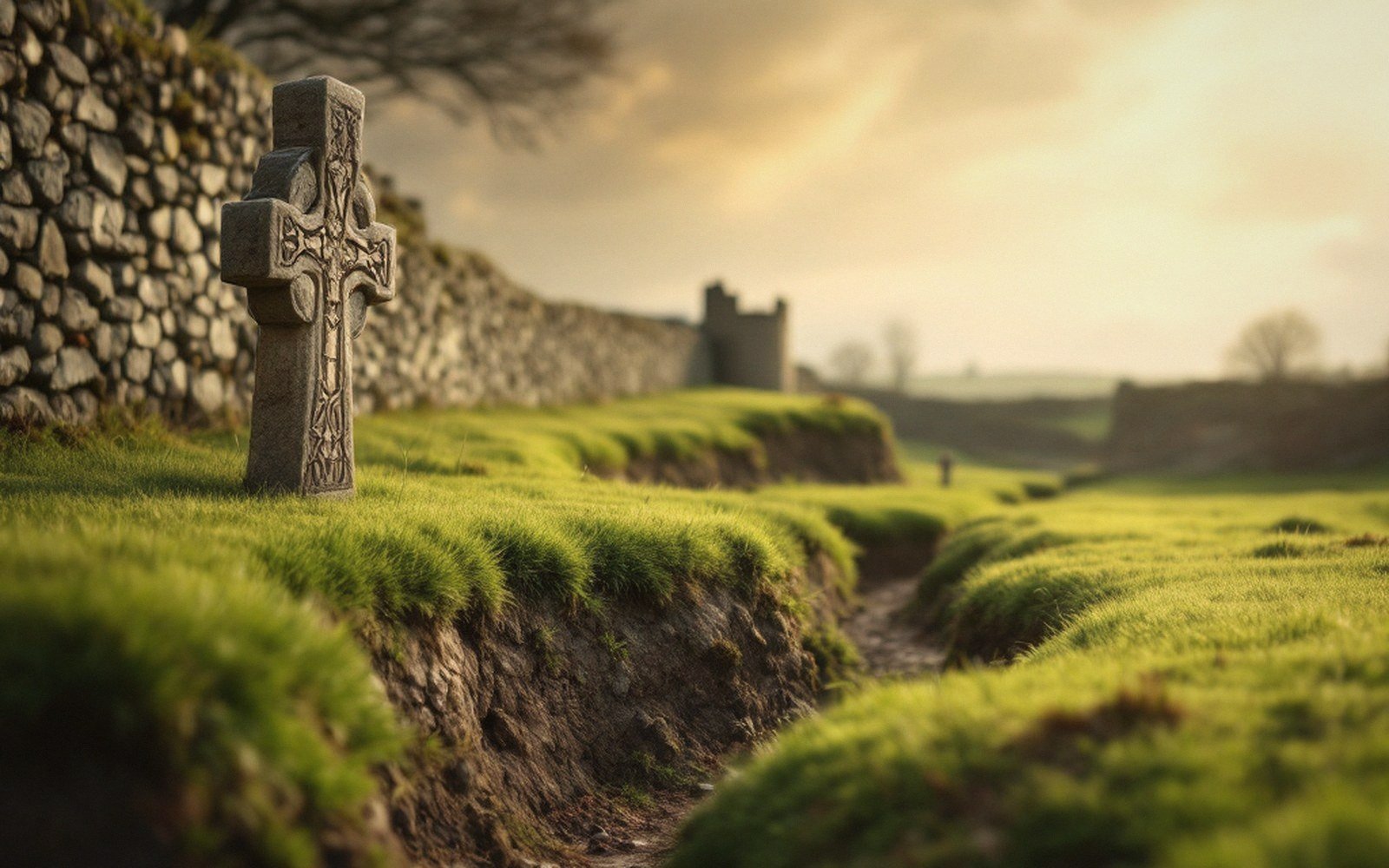
At the simplest level, the vallum is a curvilinear earthwork — a raised bank, usually with an external ditch, running in a rough oval or circle around the core of a monastic site. It is not a wall in any defensive sense. Its function was primarily jurisdictional: it marked the boundary between the termón (the sacred precinct, with its legal protections) and the ordinary world outside. Crossing it without leave had social and legal consequences that are spelled out in the law tracts.
The physical remains vary considerably. At some sites the bank survives as a prominent earthwork several metres wide and still a metre or more high; at others it has been ploughed almost flat and shows only as a cropmark or soilmark visible from the air. Ecclesiastical sites like Clonmacnoise, Kildare and Armagh preserve traces — often fossilised in townland boundaries or in the curved lines of later field systems — that allow the original enclosure to be reconstructed in plan even where the earthwork itself is gone.
Excavation has shown that the construction method varied: some valla are simple dump-and-ditch earthworks; others show evidence of revetment, stone packing or multiple phases of construction and repair. That phasing matters, because a monastic site that grew in importance would often need to enlarge its enclosure, and some sites show two or even three concentric circuits at different radii, the outer ones added as population or prestige increased. Nendrum, on Mahee Island in Strangford Lough, is the most legible excavated example: three concentric stone-walled enclosures survive, each defining a different functional zone within the site.
The interior of the enclosure is not uniformly sacred space. The innermost zone, nearest the church and burial ground, carried the highest status; craft-working, agriculture and housing for lay dependants were pushed towards the outer circuits or beyond the vallum entirely. The line the bank draws, in other words, is not simply inside versus outside — it is the beginning of a graded landscape that the archaeology of monastic sites continues to map.
Key terms
- vallum — Latin term for the enclosing bank-and-ditch system; plural valla
- termón — Old Irish legal term for the sacred precinct inside the enclosure, carrying specific legal protections
- Curvilinear — the rounded, oval or circular plan typical of Irish monastic enclosures, as opposed to rectilinear Roman or later medieval forms
Sites to know
- Nendrum, Mahee Island, Strangford Lough — the clearest surviving example of concentric enclosures; three stone-walled circuits still legible
- Clonmacnoise, Kildare, Armagh — major sites where the original vallum survives only in later boundary lines and cropmarks