The cross as a reading surface
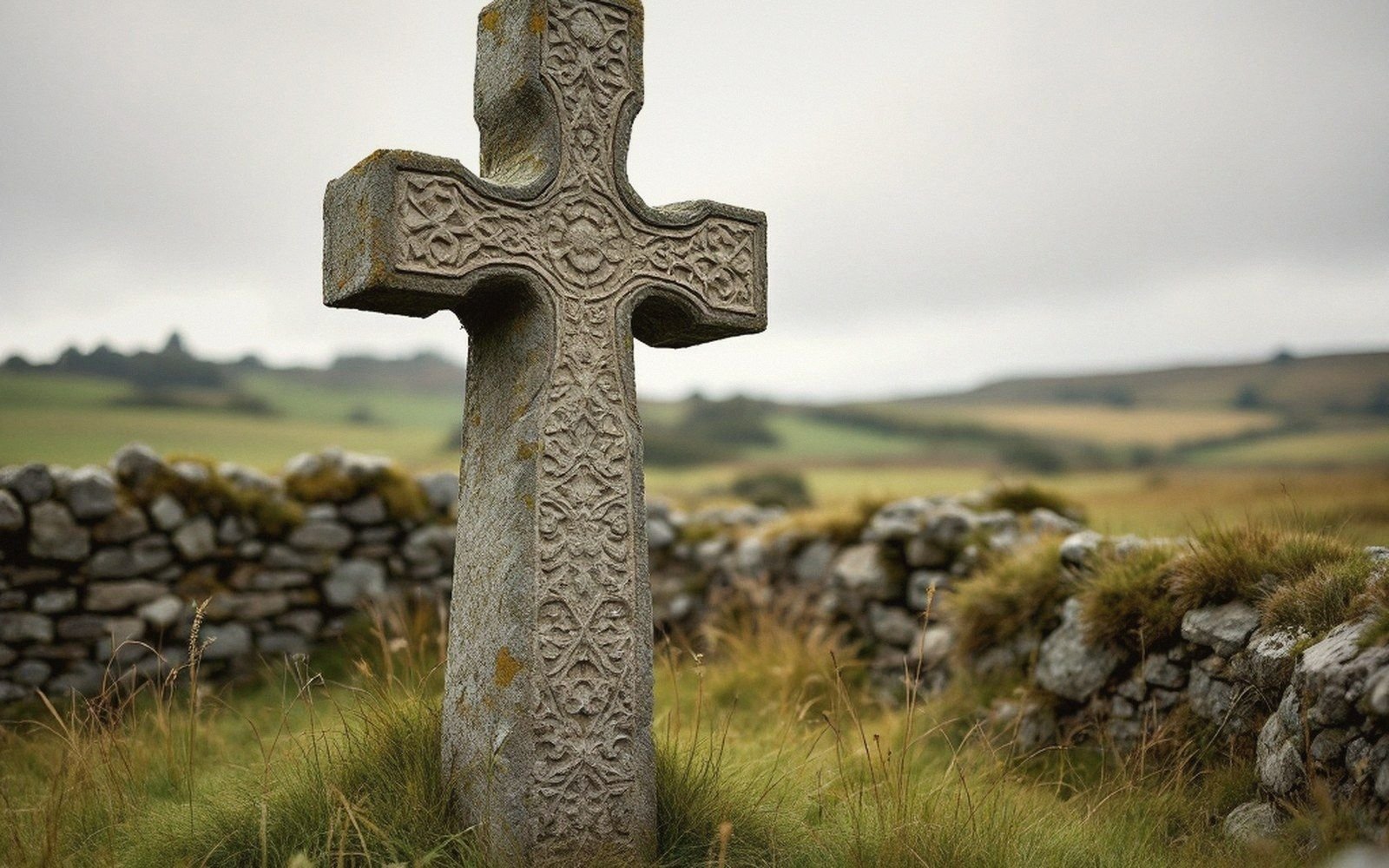
Stone doesn't need a roof. That practical fact gave the high cross one of its most remarkable functions: a public picture-cycle, readable by anyone standing in an open field, arranged on a monument that could outlast every manuscript in the scriptorium.
The carvers who worked the great figured crosses of the eighth to tenth centuries were not illustrating scripture casually. They were selecting, grouping and sequencing narrative panels with an evident programme behind them — Old Testament scenes on one face, New Testament on the other, or a vertical progression from Fall to Salvation that a viewer could trace by walking around the stone. The crosses at Moone, County Kildare, and Monasterboice, County Louth, are the clearest surviving evidence for how deliberately this was done.
At Moone, the shaft panels are almost diagrammatic: simplified, flat figures with large heads and minimal drapery, packed tightly into their fields. The Twelve Apostles appear as a grid of twelve identical bodies — identification reduced to number, not to attribute or inscription. Below them on the same face, Daniel sits between two lions whose symmetry reads as heraldic rather than naturalistic. These are not artist's failures; they are a consistent visual language calibrated for legibility at a distance, in Irish weather, on an unpolished granite surface. The cross stands roughly five metres tall; the lowest panels were always the most accessible, and the scenes there — the Sacrifice of Isaac, the Flight into Egypt, the Multiplication of Loaves — cluster the typologically paired stories that sermons also paired. The matching is not accidental.
Programme and selection
The choice of scenes on any given cross is the first analytical question. Not all of scripture is here; specific episodes recur across multiple monuments in a way that strongly implies a shared iconographic tradition rather than individual carvers working from personal choice. Adam and Eve, Cain and Abel, Noah, Daniel, David — a tight Old Testament canon appears again and again. On the New Testament face, the Crucifixion occupies the intersection of shaft and head, the structural centre of the whole monument, surrounded by the Arrest, the Mocking, and the Resurrection appearances. The programme articulates a theology of prefiguration: Isaac carrying wood prefigures Christ carrying the cross; Daniel surviving the lions prefigures the Resurrection. A congregation that heard these connections in liturgy would have recognised them in stone.
Monasterboice's Muiredach's Cross — dated by its inscription to a period in the early tenth century — compresses this visual argument with exceptional density. The Last Judgement fills the west face's head, with the saved and the damned sorted to either side of a central figure; the Moses Striking the Rock panel on the shaft below links water from stone to Baptism by a typological logic the carvers clearly understood. Scholarship has moved away from reading individual craftsmen into these programmes and toward reading them as the output of communities with access to illustrated gospel books, exegetical texts and perhaps model-books now entirely lost.
The Mediterranean parallels are real but indirect. Ivory diptychs, painted panels and sarcophagus reliefs show similar programmatic arrangements — Daniel between lions appears in Roman catacomb painting centuries before any Irish cross — but the specific Insular selection and the monument's three-dimensional character are not simply imported. The cross-head, seen from changing angles as a viewer moves around it, creates a sequence that no flat surface can replicate. Weather, scale, and stone all reshaped what continental models may have supplied.
Key sites mentioned
- Moone, County Kildare — granite high cross, simplified figural style, c. five metres tall
- Monasterboice, County Louth — Muiredach's Cross, early tenth century, inscribed
What survives is already filtered by a thousand years of exposure. Weathering has erased details that once clarified identity and sequence; panels that now look generic were perhaps once painted, with colour doing work the stone alone cannot. The readable monument and the monument as it stood in the ninth century are not the same object.
Raking Light is an independent publication about early medieval material culture. It is not a church, museum, diocesan body or tourism service.
Recurring Old Testament scenes (cross-site pattern)
- Adam and Eve
- Cain and Abel
- Noah
- Daniel in the Lions' Den
- Sacrifice of Isaac
- David