
What it is and where it sits
The term is modern. Scholars borrowed "carpet" from Islamic art studies because the effect is comparable: a flat field of interlocking pattern with no perspectival depth and no narrative content. In gospel books of the Insular tradition — produced across Ireland and in Irish-founded monasteries in Britain and on the Continent from roughly the late sixth century onwards — a carpet page typically precedes the decorated opening of a gospel, acting as a visual threshold between ordinary reading and the sacred text ahead.
The pages are not decorative surplus. Their placement is structural. In the Book of Durrow, the earliest surviving Insular example with carpet pages intact, the ornamental page faces the evangelist portrait or the decorated incipit — the opening words — of each gospel. The pairing is deliberate: you pass through the carpet to reach the word. In the Book of Kells the carpet pages are fewer and their positioning less systematic, probably because the manuscript was never finished, but the principle holds.
What fills the field varies, and the variation is itself chronologically informative. Durrow relies heavily on interlace — knotted bands that loop and cross without resolving — alongside simplified zoomorphic (animal-form) ornament. The Lindisfarne Gospels, produced in Northumbria under strong Irish influence around the early eighth century, push the zoomorphic element to an extreme: entire pages are resolved, on close inspection, into interlocked birds and beasts, their bodies forming the very knots of the pattern. Spiral work, step patterns and fret panels provide contrast and structure within the same page.
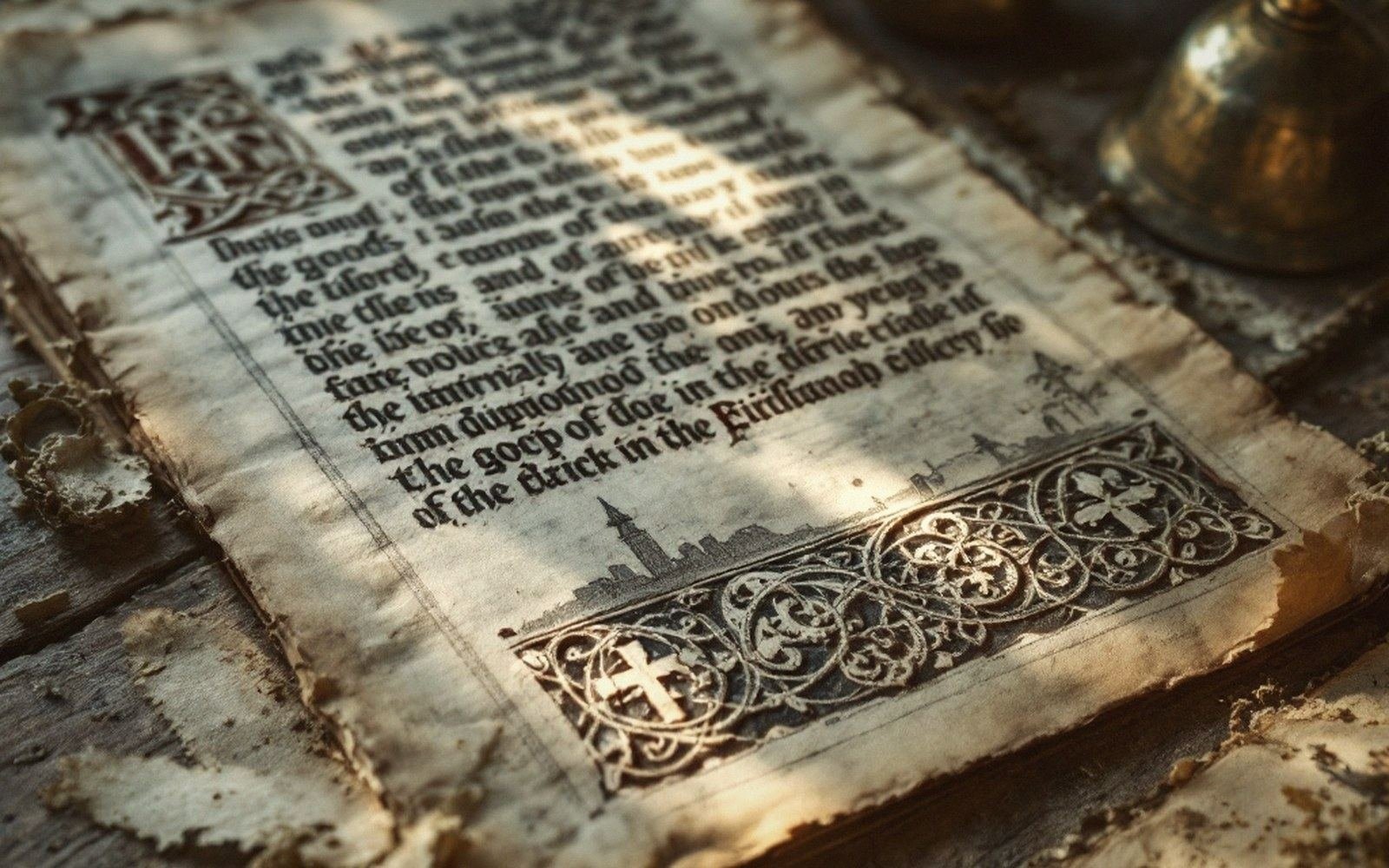
The geometry is not freehand. Physical evidence of pricking — pinprick guides in the vellum — and ruling with a stylus survives in several manuscripts, and the regularity of the knotwork has led researchers to model the underdrawing techniques likely used. The densest passages operate at a scale where the human eye loses count of the individual strands, and the pigments on some pages are applied in layers thinner than the unaided eye can distinguish.
There is no scholarly consensus on the deeper significance of the form — whether the carpet page is apotropaic, meditational, cosmological, or primarily the demonstration of an artist's command over chaos and complexity. The physical record shows only that considerable skill and time were invested, that the convention was transmitted across generations and across the Irish Sea, and that it was considered indispensable to a gospel book of any ambition.
Chronology
- Seventh century — carpet pages established in Insular gospel production
- Book of Durrow — earliest intact Insular examples; exact date debated, broad scholarly range c. 650–700
- Lindisfarne Gospels — early eighth century, Northumbria; strong Irish-tradition influence
- Book of Kells — late eighth or early ninth century; carpet pages incomplete
Technical terms
- Carpet page — modern scholarly term for a full-page ornamental folio with no text
- Insular — modern term for the shared artistic tradition of Ireland and Irish-influenced Britain
- Incipit — the opening words of a gospel, typically given monumental decorated treatment
- Interlace — knotted-band pattern that loops without resolving; foundational Insular motif
- Zoomorphic — animal-form ornament; bodies of creatures resolved into decorative bands
- Pricking — pinprick guides pressed through vellum to transfer geometric layouts