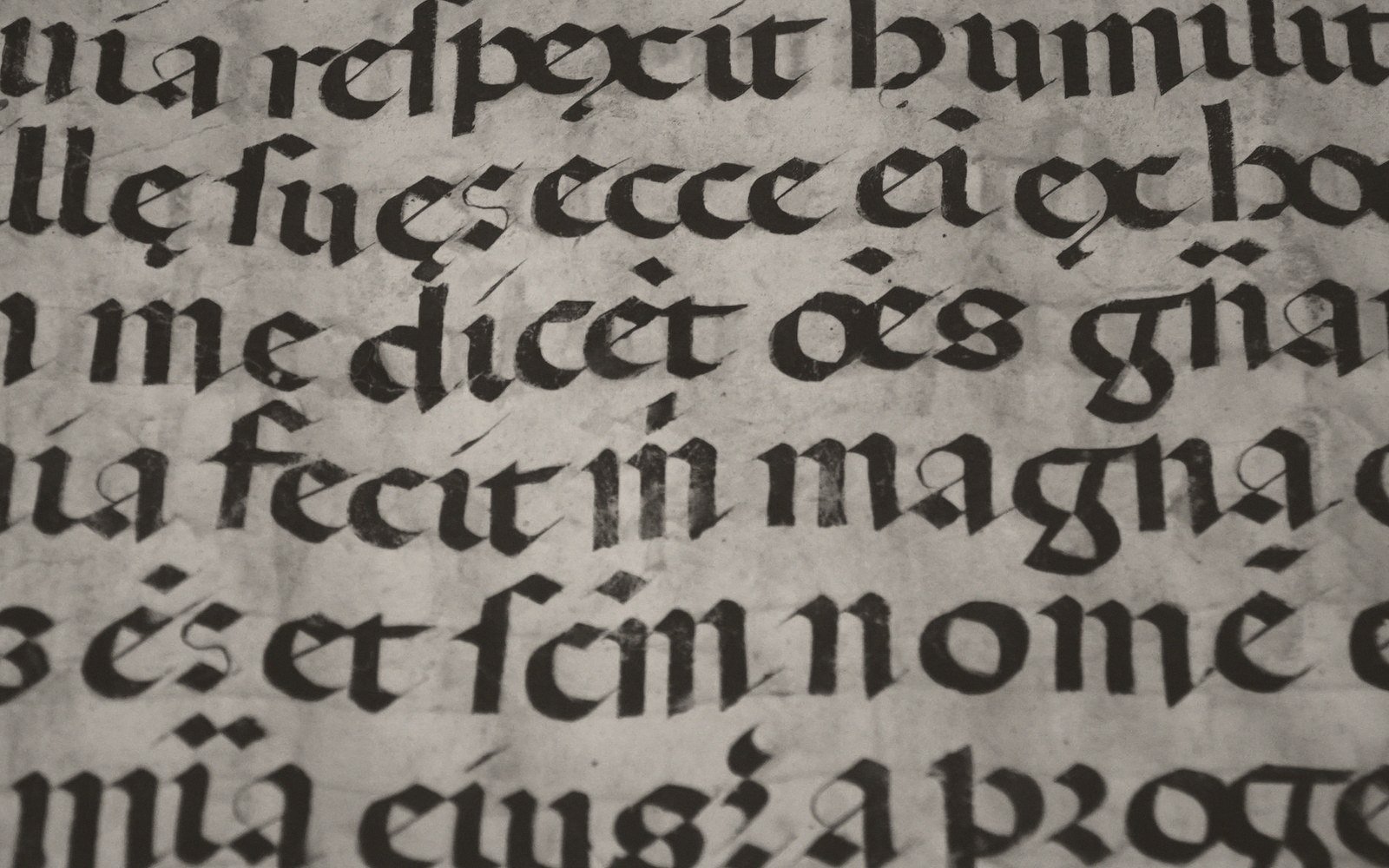
A script with a specific profile
Insular majuscule is the formal bookhand used in the great Irish and Hiberno-Saxon gospel books of the seventh to ninth centuries — the Book of Kells, the Book of Durrow, the Lindisfarne Gospels, the Lichfield Gospels. The word insular signals origin in the islands of Britain and Ireland rather than the continental tradition; majuscule means a script written largely between two horizontal lines, with few ascending or descending strokes. It is neither Roman uncial nor the cursive minuscule that follows it chronologically; it occupies its own structural niche.
The key diagnostic letter-forms are consistent enough that a trained palaeographer can identify the hand at a glance. The letter a is typically of the uncial type, with a rounded bowl and an open top that can resemble the letters oc. The g has a distinctive open tail that loops to the left. The d is often wedge-topped. Abbreviation marks — the horizontal bar for m or n, the superscript letters for common contractions — follow conventions that differ visibly from continental practice. Serifs are triangular, applied with the broad quill held at an angle that leaves a characteristic thick-thin stroke contrast. The overall impression is dense and upright, not cursive.
Insular minuscule — a smaller, faster hand often used for glosses or annotations in the margins — appears alongside majuscule in many manuscripts, and the two can be distinguished by relative scale and the degree to which letters are joined. The Würzburg Pauline Epistles and the St Gall gospels, both associated with Irish missionaries on the continent, show this mixture clearly.

Dating by letterform
Dating manuscripts by palaeography alone is imprecise and scholars say so. Letterform analysis places a script within a rough bracket of half a century or more; it cannot yield a year. The comparison pool — manuscripts with secure external dates, such as a colophon or an associated charter — is smaller than it looks, because many apparent anchor-points rest on tradition rather than documentation.
What palaeography does offer is relative sequencing. Earlier insular majuscule tends toward looser, more variable letterforms; later examples become more regularised and then, toward the ninth century, show the first incursions of continental Caroline minuscule as scriptoria came into contact with Frankish practice. The point at which a manuscript shifts from insular to Caroline or shows hybrid forms is itself evidence of date and cultural context, traceable through vellum and pigment analysis alongside the letterforms.
Key letterforms
- a — single-compartment, closed and rounded; diagnostic for the script
- g — open tail looping left; a quick identifier
- d — often wedge-topped, distinct from Roman models
- Abbreviation marks — follow insular conventions, visibly different from continental usage
- Thick-thin contrast — produced by broad quill held at a consistent angle
What palaeography can and cannot tell you
- Can do — place a script in a rough bracket of half a century or more; establish relative sequencing across manuscripts
- Cannot do — yield a precise year; anchor a date without a colophon, charter or other external evidence
- Hybrid forms — the mixing of insular majuscule with Caroline minuscule from the ninth century onward is itself dating evidence