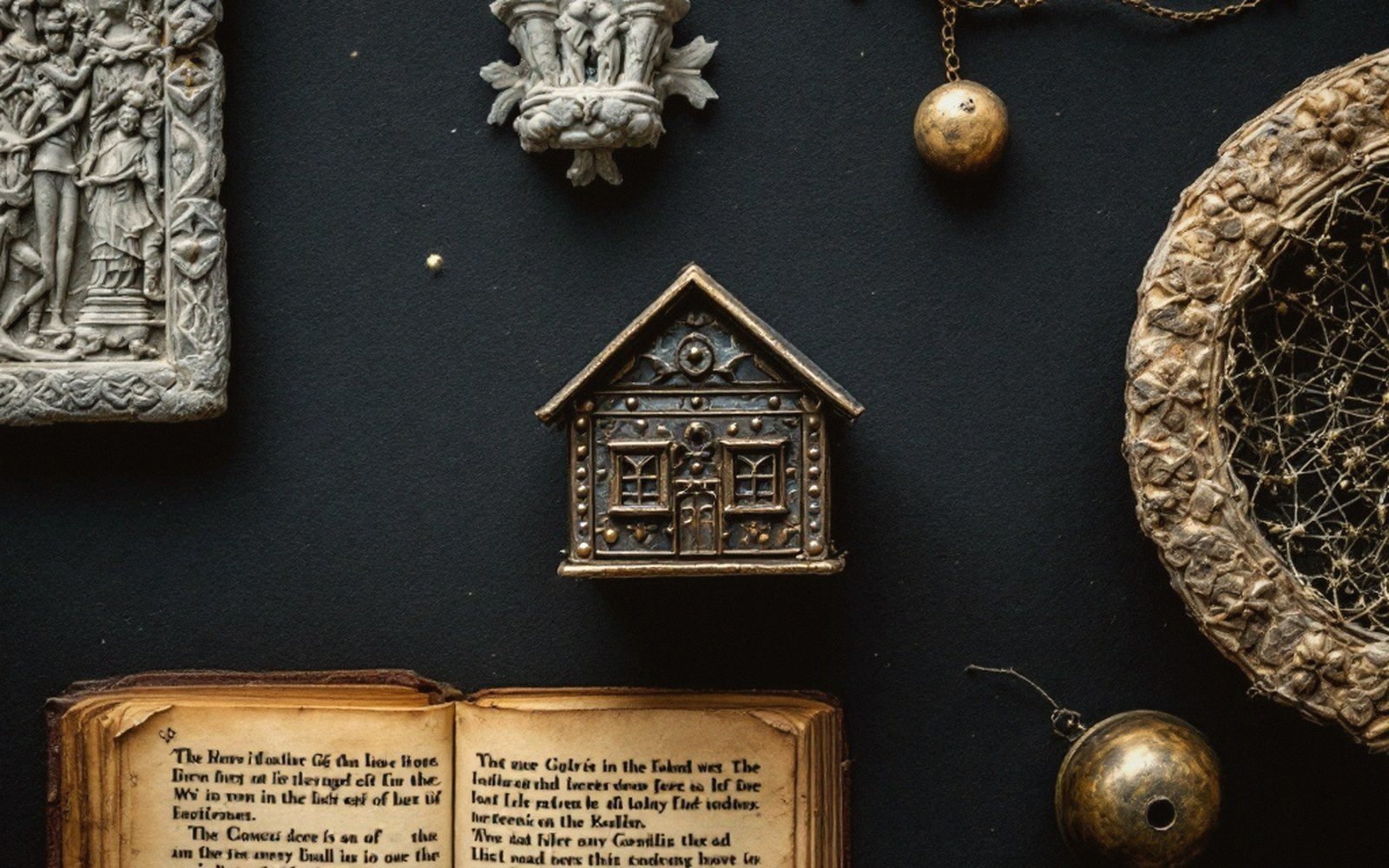
A Box Built Like a Building
The characteristic form of early medieval Irish reliquaries is a miniature house: a rectangular base, a pitched or gabled lid, and a hinge or latch at one end. The shape is not incidental. It echoes the shrines of continental Europe and, more distantly, late-antique sarcophagus forms, but in Ireland it was developed with particular consistency from roughly the eighth century onward. The largest surviving examples are around twenty centimetres long; most are smaller. They were made to be handled, carried into battle, sworn upon, and displayed at assemblies.
The materials are layered. A wooden substrate — usually yew, which resists splitting — provides the structural core. Over it the metalworker fitted plates of bronze, then applied decoration: interlace, animal ornament, and occasionally figural panels in high relief, executed in gilded silver or in cast and engraved bronze. The surfaces of some examples also carry filigree and granulation, that combination of gold wire and tiny spheres that requires tools and a steady hand at magnification. Enamel insets, usually in red or yellow, punctuate the ornamental fields. The ambition is hierarchical: the most elaborate surfaces face outward.
What the box contained varied and is rarely preserved. Bones are the expected contents — a fragment of a founding saint, most often — but textile relics, communion vessels, and even books were housed in comparable containers. The Irish term miosach (book-shrine) distinguishes that class, and cumdach describes a book's outer cover-shrine specifically, though the constructional logic is the same as the house-shaped relic-box.
Several key examples survive in museum collections in Ireland, Britain and the United States. The Emly Shrine, now in the Museum of Fine Arts in Boston, dates to around the eighth or ninth century and retains its gabled lid and some original metalwork. The Lough Erne Shrine in the National Museum of Ireland and the fragmentary pieces at the British Museum extend the corpus across two or three centuries of production. None is exactly like another: the form is consistent, the ornamental programmes are individual.
The handles, rings, and carrying loops that appear on many shrines are original fittings. These objects were not made for permanent display behind glass. They accompanied the community — on circuit to collect dues, into disputes as an oath-object, into conflict as a guarantee of divine support. The damage many show, the replaced panels and repaired hinges, is the record of that use, not of neglect.
Key terms
- miosach — Irish: a book-shrine; a reliquary made specifically to contain a gospel book
- cumdach — Irish: the outer cover-shrine for a manuscript; closely related in construction to the house-shaped relic-box
- Vallum — the enclosing boundary of a monastic site, the institutional context within which these objects were made and kept
Surviving examples
- Emly Shrine — eighth–ninth century; Museum of Fine Arts, Boston; gabled lid, original metalwork partly intact
- Lough Erne Shrine — National Museum of Ireland, Dublin
- British Museum — holds additional fragmentary Irish reliquary metalwork